|
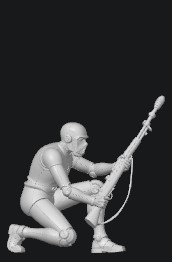
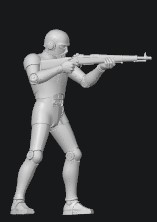
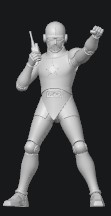
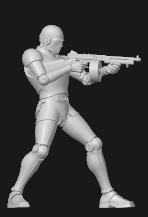
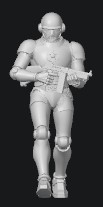
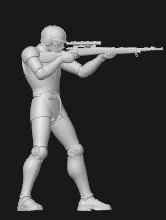
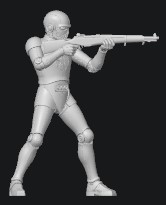
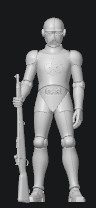
Beyond The Battlefield 3D Printed figurines 1/72, 28mm & 1/35. Printer DLP & Tough Resin.
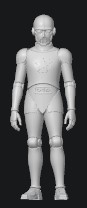
3DHM-81. U.S. WAR AUTOMATONS 1941/45 Scale 1/72: 2.50€ per figurine // Scale 28mm: 4€ per figurine TO ORDER: Select the reference numbers and scale, then contact us at studio@3dhistoricminiature.com
ENGLISH
This is
the history of the most extraordinary device ever used in the US Army
inventory, the M-1, Personnel, Automaton, eLectronic; pronounced “PAL.”
Only now, seventy years after their invention has their role in the
Second World War been revealed to the public for the first time and the
incredible achievements of their inventor made known.
As early
as the First World War the US military was working on pilot-less target
drones to help train pilots. They tried various methods of remote
control or self controlled vehicles and aircraft. The major user
turned out to be the Army Air Corps for training fighter pilots and
Coast Defense Corps for training anti-aircraft gunners. None of
these devices was very sophisticated and none were ever good enough to
be used in combat. Real human soldiers and airmen had to face the
rigors and dangers of real warfare.
The United
States Automaton Corporation, USA Corp. as it was called, was founded in
1919 as a way to reduce casualties in war. Dr. Ernest W.
Handricksen, brain surgeon, and former CPT US Medical Corps, late of
France in the Great War, was the founder and chief designer of the PAeL
system.
Coming
from a musical family, Ernest Handricksen was expected to follow his
mother and father into show business. Instead, his musical talent
was more mechanical and technical than inspirational. Still, it
was good enough that he could work as a piano tuner and pay his way
through medical school in the years before the First World War. Dr.
Handricksen continued his studies until he became a brain surgeon of
some regional renown in the Western United States.
When war
with Germany came he enlisted as a doctor and was with some of the first
American soldiers sent to France. Working on men injured in
training accidents and later combat he was appalled at the human wastage
and vowed to do something about it when the war was over.
While on
leave in Paris he visited a museum and learned of the work of the French
scientist, Jacques de Vaucanson. He had made automatons for the
amusement of the royal court centuries earlier. As a brain surgeon
in the US Army in France Dr. Handricksen saw the human body was like a
machine, so why not make a machine like a human body? If a soldier
could be replaced by a machine, the machine would not suffer pain and
could be replaced or repaired by technicians in the field.
When the
Armistice was signed in 1918, Dr. Handricksen returned to civilian life
but wanted nothing to do with medicine for a while, so he could think
about his next project. Working as an electrician and later for
the telephone company to pay the bills, at night he would stay up late,
working on designs for his human machine. By 1926 he realized he
would need more money to build his automaton and so he returned to
medicine.
Founding a
small clinic south of Los Angeles, California, he treated the rich who
frequented the beaches and spas in the area. At the rear of his
clinic he built a laboratory to begin experimenting with his ideas for a
human machine. By 1930 he had the final designs completed and he
began construction of prototypes.
In 1937
until 1941, Dr. Handricksen went to France for two to three weeks every
summer. He learned more about the works of Jacques de Vaucanson.
He also founded a small subsidiary of his company, and called it the
Société française d'automates, French Automaton Corporation.
Several young French scientists and engineers worked on the PAeL project,
primarily on the power generation and supply. Power generation was
headquartered in Paris and power supply was designed in Vichy.
The result
was that by late 1940, he introduced to the US Army his prototype for an
automaton soldier. Impressed with the demonstration the Army
ordered a test battalion based on a regular human battalion. Due
to the very limited reasoning ability of the automaton, each automaton
was assigned to a human soldier on a one to one ratio. So each
unit was 50% humans and 50% automaton soldiers.
The unit
took part in the Louisiana Maneuvers of 1940 with good results.
The automatons maintained a high operational rate and performed their
duties as expected. The project was given the go ahead to proceed
with larger units.
The U.S.
Army Automaton Corps was formed on September 14, 1941 with two divisions
on paper, formed from one under strength National Guard division that
was activated into Federal service. Due to the rapid expansion of
the Army after Pearl Harbor the troops to form two divisions were not
available, even the activated division was raided for troops to form the
cadre of other new divisions. As a result, it was decided to start
with a single regiment of infantry, the 1138th Regiment, Troop, Human,
Experimental.
Each
automaton had a control box in their chest and a sensor unit in their
head. The sensor unit and control boxes were hand made by Dr.
Handricksen. These devices were so secret that they were not even
patented. Breaking one open allowed a certain liquid to escape and
rendered the device useless. The devices were sealed at the
factory and in the field could be replaced with a new unit, but could
not be repaired.
The other
components were made in Dr. Handricksens small workshop behind his
clinic in California. Once the contract was lent for the first
Corps Dr. Handricksen purchased a small factory and began series
production in early 1941. Most of the employees were from the
local area, both men and women. Dr. Handricksen continued to make
the control and sensor boxes himself in his workshop.
Many of
the workers were Americans of Japanese ancestry and so when orders were
given to intern them, nearly his entire workforce was taken away.
Months of training his staff was wasted as his staff was now interned
and unavailable to perform defense work. Weeks of wrangling with
the military authorities and even a couple trips to Washington got him
nothing and so Dr. Handricksen had to start over recruiting new workers
and training them to make the automatons. Of course, the real
solution to the problem was to simply train the automatons to make more
automatons but it just did not occur to anyone at the time!
By now the
Army had ordered 15,246 units to fill out the proposed two divisions.
Since Dr. Handricksen was only able to make a dozen or so control units
per day, it would have taken years to get to the number of automatons
ordered by the Army. Others were brought in to help Dr.
Handricksen but he took ten years to learn how to make these control
units and he was a brain surgeon. They estimated it would take
five to seven years to learn how to make the control boxes and sensor
units.
While they
could not learn how to make the control boxes and sensor units, the
assistants did learn how to make some of the sub-assemblies that went
into the control boxes and particularly the sensor units. With
their help production rates were increased from ten to twelve per day to
an average of 36 units per day. Two technicians were also assigned
to on the job training with Dr. Handricksen to begin the years of
training needed to make the units on their own. Over 30,000 PAeL
units were known to have been produced during the war with some
estimates of almost 50,000 units.
They
worked five days per week but took off every weekend. The work was
tedious and difficult and production fell off after about ten hours.
Two full days were required for recovery so the eyestrain and hands were
calm enough to resume work for the week. Dr. Handricksen was
fifty-five years old when he founded the company and the strain of
wartime production was taking its toll on him.
In
November, 1941, a provisional platoon was shipped to the Philippines.
The unit consisted of four 6 man squads, each with 5 automatons.
The platoon headquarters was nine humans, including two civilian
technicians from the US Automaton Corporation as advisors. The
automatons were still secret which limited what they could do and so
initially they were kept at Ft. Frank, on Carabao, one of the fortified
islands in Manila Bay. They were mostly employed as stevedores and
digging fortifications and filling sandbags.
The
automatons naturally did not suffer from disease, but their human
counterparts began to drop like flies soon after their arrival in the
Philippines. The thirty-three humans were reduced to only fourteen
by the beginning of February, 1942 due to disease, wounds and accidents.
Since each automaton required a human PAL to operate, the unit was
significantly degraded.
Just as
the humans were stricken by disease, the automatons began to fall victim
to the damp. The USA Corp. representatives had been sending
messages back, almost from the beginning, that the automatons were not
able to resist the effects of climate and salt water on the island.
Corporation
representatives on the Philippines made some changes and were able to
keep many of the automatons running. Dr. Handricksen began
redesign of the electrical components to be more salt water and rust
resistant. The reports of poor salt water resistance caused both
the Navy and the Marine Corp to lose interest in the project.
In an
effort to salvage something from the project in the Philippines, the
remaining soldiers and automatons were reorganized into one large squad
of twelve men and the ten remaining functioning automatons. They
deployed to Bataan and there is some evidence that they participated in
combat patrols and may have encountered Japanese patrols. After a
couple weeks all the troops and automatons were taken back to Carabao
and then all the automatons, functioning or not were taken to Army
headquarters on Corregidor Island.
General
Douglas Mac Arthur himself praised the hard work of the soldiers in the
Automation Platoon and requested more such soldiers for the defense of
the Philippines. Saying in part in a secret communiqué:
“The hard work and dedication of these soldiers and the enthusiasm
they have for their electronic charges is truly inspirational.
This command would welcome as many of these PAeL teams as can be
sent.”
Despite
the capture of over 50,000 US Army and Philippine troops all the
automatons we evacuated from the island in a US Navy submarine, as
ballast! The submarine made a short stop at Pearl Harbor where the
automatons were removed, cleaned, crated and then sent back to the Navy
base in Long Beach, California. The two USA Corp. technicians, and
several of the soldiers who had served with automatons were able to
return on the submarine with the information they had gathered.
Corregidor fell only a week later.
From there
they were picked up by USA Corp. employees and taken back to the factory
for analysis and repair. Dr. Handricksen was able to make a few
adjustments and solve the rusting and corrosion problems. This in
turn further delayed the deployment of the automations on a large scale
basis.
Just after
Pearl Harbor, The USA Corp. tried to send another representative and
twelve additional PAeL units to the Philippines. While enroute
there, their aircraft put down at Wake Island with engine trouble.
After unloading the cargo the plane returned to Hawaii. The USA
Corp. representative stayed with the PAeL charges, hoping to finish the
trip to the Philippines or make use of them in the defense of Wake
Island.
The
contractor and the PAeL automatons he had with him were never heard from
again. There is no record of him being taken prisoner or of being
removed from the island by friendly forces. No mention of PAeL
soldiers is recorded from the records of Wake Island defenders, but that
could be due to wartime secrecy. It is thought that the Japanese
may have captured the twelve PAeL units, but there is no record that
they captured them or what happened to them.
By the
time of the Army landing on Guadalcanal in October, 1942, the Army had a
fully operational company of over 100 automatons and a like number of
human soldiers. When Army troops took over control of the island,
Able Company, 1st Battalion, 1138th Infantry Regiment, Troop, Human,
Experimental landed with them.
In North
Africa, rather than land at Casablanca with the bulk of the troops they
were assigned to land at a small inlet just south of the city in
November, 1942. The unit was Easy Company, 2nd Battalion, 1138th
Infantry Regiment, Troop, Human, Experimental. Like the company on
Guadalcanal they were composed of over 100 human soldiers and another
100 automatons.
General
Patton hated the idea of using automation soldiers and so he kept them
in their troop ships until almost all other troops had landed.
Only when the Navy wanted their ship back did he consent for them to
land. Once again reduced to stevedore duties and filling sandbags
their full potential was not realized. At least one PAeL was
captured by the Vichy French and sent on to the Germans.
In a
report to General Eisenhower, Patton wrote, “The glory of war is for
men. If men must share this glory it should be with war horse and
war dog, and not a mechanical contrivance made not in the image of God
but in the image of man.” As a result, the company and the
remainder of the battalion were shipped to General Lloyd Fredendall in
Tunisia.
In March
of 1943 General Fredendall was relieved of command by General Patton and
once again the automatons were out of favor with the high command.
In an
effort to rid himself of these automatons, a second time, General Patton
created a series of legal questions to tie them up from ever seeing
combat, or at least minimize the numbers of them under his command.
Are these
lawful combatants under the Geneva conventions?
If
captured are the Germans required to treat these machines as human
soldiers?
Are human
soldiers required by military law to take orders from machine devices?
Patton
even made a statement to the press that “While military men may be
seen as machines, machines should not be seen as military men.”
The project was so secret that General Eisenhower was able to get the
story suppressed and in the event it was only published by The Review, a
small weekly paper in South Pasadena, California.
Those PAeL
Automatons who were left over from Tunisia were formed into assault
groups for the invasion of Sicily. General Patton was slated to
land with four battalions of PAeL troops but due to his dislike of them
he managed to have two battalions transferred to the paratroopers.
The first
ones for airborne assault were used in Sicily. In test jumps a
major percentage of Automatons broke their ankles. A pair of pins
that held the leg onto the foot was sheared off and one or both feet
were often torn off upon landing.
One
battalion trained all their men to repair their PAeL troops after a hard
landing.
Each
paratrooper assault battalion took a different tack to try and overcome
this problem. One battalion tried training their soldiers to
repair the damage to their PAeLs. Extra parts were made available
and the Automatons jumped with their PAeLs.
The second
paratrooper battalion tried training the PAeLs to repair themselves, but
they just did not quite bend that way. They tried to get them to
repair each other, but they seemed to refuse to learn how to do that.
One battalion even took to calling the PAeL soldiers “mules” for
their stubbornness. For the jump they 2nd battalion placed the
PAeLs in cargo drop containers. This solved the problem of broken
ankles, but created problems of its own.
The PAeLs
could not remove themselves from inside the boxes. Once the cargo
container was dropped the PAeL was trapped inside until a soldier could
release them.
The
airborne phase of the Sicily invasion was a disaster. Friendly
fire from the invasion fleet hit many of the planes carrying
paratroopers and PAeL troops. Many PAeL units went down with the
planes or were jettisoned to make the planes lighter so they could avoid
crash landings.
All of
those PAeLs that landed in the ocean inside cargo containers were
destroyed. Those that landed by parachute in shallow water were
often able to walk along the bottom and make it to shore. One PAeL
is known to have spent three days underwater before finally walking up
on the landing beach.
Unlike
General Patton, the Luftwaffe was very enthusiastic to get as many PAeL
units as they could get their hands on. They were intended to use
the piloted V-1 and V-2 missile system systems. The Army was
dubious of this new technology, but the SS was very interested too and
they obtained at least a few PAeL units to supplement their own rather
advanced automaton program at the King Frederick the Great of Prussia
Center for Automaton Research.
The Vichy
French and the SS cooperated in the formation of the Jacques de
Vaucanson Technical Institute to study the PAeL device, with facilities
at both Vichy and Paris. As a result the Germans developed their
own automation and deployed some of them on the Eastern Front. In
secret meetings with Vichy French officials the Germans agreed to permit
the French to manufacture automatons and send them to Russia in lieu of
drafting French citizens to fight in the German army or sending troops
there to fight there directly. The Soviet Union is known to have
captured a few from the Germans.
The PAeL
Automatons served nearly everywhere US Army troops served in World War
Two. Many soldiers did not like serving with them. Their
limited artificial intelligence meant that each PAeL had to have a human
Pal to direct them. Since PAeL did not eat or drink, soldiers
could not share a cup of coffee or a meal with them. Since the
early versions could not speak, they could not have a conversation with
their human counterparts.
The PAeL
troops were designed to identify the enemy by the presence of enemy gear,
especially headgear and weapons. The German helmet, the M43
Feldmutze cap, the German Kar-98 rifle, the German metal gas mask
canister were key items of identification. When the PAeL did not
detect these features they often would not fire on the enemy.
Initially
they plan was to replace 50% of all units with PAeL Automatons, but soon
it was realized that it was not practical for all units. Mess
facilities were reduced to half size total with only 25% of the original
human staffing. Medical units were reduced by 40% of their size,
but this was made up by the need for repair teams for the PAeL
Automatons. PAeL repair teams were co-located with medical
units.
While PAeL
soldiers did not really need clothing as such, it was realized that the
distinctive US Army helmet was a key identifier of friendly troops.
As such, the PAeL was often known to wear a helmet, and sometimes a
uniform shirt. They had no practical reason to wear pants or boots
and seldom wore them.
PAeL
Automatons were the same size and weight as a large human solder, in the
same proportions. They were six feet, two inches tall and weighted
250 pounds. They were designed as small as possible but Dr.
Handricksen wanted them to be able to fit inside human vehicles, use
human furniture and most importantly, human weapons.
While made
of metal, the PAeL was not really bullet proof. They were
deactivated with a gunshot to the head or center of chest. They
did not feel pain and so would continue to fight even with terrible
damage. They would never surrender as a part of their programming
but would stop fighting and deactivate themselves at the order of their
human Pal.
PAeL
Automatons ran on electricity. They could be recharged from any
automobile recharging system. Clips from the PAeL battery system
could be attached to the vehicle battery and with the engine running the
PAeL battery would be recharged in under an hour. PAeL batteries
were usually recharged at charging stations and swapped out every day.
Some human
soldiers would use the PAeL Automaton as a virtual slave. Digging
their foxholes, and even using them as shields in combat were a few of
the practices done by some “slackers.” These practices were
officially prohibited and most soldiers greatly disrespected those
soldiers who “mistreated” their Automaton.
Other
soldiers loved serving with the PAeL soldiers and called them G.I. Joey,
rather than G.I. Joe. They were often referred to as Pal Joey in
dispatches, since they were classified.
Not long
after the war, Dr. Handricksen was so worn out by his efforts in
building the machines that he was forced to retire. He stopped
building automatons and he ceased his medical practice by 1946.
His company, the United States Automaton Corporation was all but
bankrupt and he let all his employees go with the cession of war
production. Dr. Handricksen died in obscurity in 1990.
There was
some talk of declassifying the project and permitting the automatons to
be used in civilian industry, but with the high unemployment following
the massive wartime demobilization that idea was turned down. The
remaining automatons were serviced and carefully packed away and stored
in military warehouses in the California desert.
During
both the Korean War and the Viet Nam Wars the PAeL program was re-initiated
with small numbers of the automatons serving their nation again in Army
uniforms. By 1973 with the withdrawal of all US military combat
troops from Viet Nam there was talk of replacing most of them with PAeL
soldiers but it was determined that there were not enough of them in
stock to make a difference in a large unconventional war. Both
times these mechanical veterans were cleaned, oiled, boxed up and
returned to those warehouses in the California desert. Some of
them had served in all three wars.
Sometimes
a government becomes so vast and bureaucratic that it cannot even
remember its own secrets. Some parts of it just get renewed out of
habit and a desire not to cut a program that has provided jobs in a
small community for decades. This is true for the program
that stored PAeL system automatons in military warehouses in the
California desert. The warehouses were well built and required
minimal maintenance. They contained large numbers of automatons
and vast amounts of WWII era and later Cold War weapons, vehicles, and
equipment. There was even a small museum that no one ever visited.
The need
for caretakers and security staff was small and the funds supported a
small town that was near the base where the warehouses were located.
Despite the ups and downs of government funding the warehouses continued
to store their secrets, with few people really understanding the nature
of the items stored there. Over time, what was actually stored
there became unimportant. To the congressmen who represented the
area over the decades it was important as a jobs creation project.
The jobs created by the warehouses helped to keep people voting for him
as long as the warehouses jobs kept them employed.
Many
decades passed and the warehouses were guarded. The gravel was
raked, the rocks painted and people forget exactly what was stored there.
With peace, there was little reason to inspect the contents. The
tanks, artillery, trucks and PAeL Automatons stayed sealed up in crates,
in perfect condition for over a century.
Earthmen
had found their way to other planets. A century after the end of
World War Two humans found other intelligent life. One day a war
broke out in outer space with that life. No one knows exactly what
happened, but Earth was suddenly at war with an enemy on another planet.
The Earth need for war machines was very pressing. The enemy had
vast numbers but their technological development was not advanced.
Even old weapons technology would work against this enemy.
The old
warehouses were opened and the contents examined. Most of it was
equipment from the middle to late 20th Century. It included vast
numbers of automatons from the PAeL system. They were taken out of
storage and sent into space by transport ships operated by the Earth
Space Transport Command.
From low
orbit they were transferred, along with a large number of military
vehicles and tanks from a period called World War Two, into several huge
transport vessels. Earth Space Transport Command sent dozens of
transport ships into space, carrying weapons that were as much as a
century old.
These
ancient warriors continue to serve long after the war they were built
for was over.
Contact : studio@3dhistoricminiature.com https://www.instagram.com/3dhistoricminiature/
|
||||||||||||||||||||||||||||||||||||||||||||||||||||||||||||||||||